Choosing between sewer line repair vs replacement in Sarasota comes down to four inputs: pipe condition on camera, depth and access, whether the failure is localized or structural, and how much disruption your property can absorb. Homeowners who weigh those inputs in order almost always land on the right scope the first time. Skip the evaluation, and the same stretch of pipe can end up getting paid for twice.
Start With the Camera, Not the Backhoe
Every sound decision starts with a camera inspection of the full run. A video pass shows where the pipe sags, cracks, or blocks, and it separates a single defective joint from a line that has failed along its length. Without that footage, any scope you approve is an estimate layered over guesswork.
Findings sort into three practical buckets. Localized defects live in one place, like a cracked segment or an offset joint at a connection. Pattern problems repeat, such as roots at several joints or corrosion thinned across a long reach. Structural failures change the pipe itself, where the wall has collapsed or lost its shape entirely.
Ask for a copy of the recording before you approve anything. Footage documents pre-existing conditions, guides the scope decision, and gives you a baseline to compare against once the work is finished. A contractor who hesitates to share it is doing you no favors.
Depth and Access Change the Math
Two houses can share the same defect and still get different recommendations because of geometry. A shallow lateral under open lawn is comparatively easy to reach, so excavation stays reasonable. One crossing a driveway, a pool deck, or mature landscaping shifts the math toward methods that need less digging.
Access matters on the working end too. If the only cleanout sits far from the defect, or the run bends through tight turns, some tools and liners have a harder time reaching the problem. Crews factor that into the plan, and so should you.
Localized Defect or Structural Failure?
This is the hinge of the whole decision. A localized defect lives in one spot: a cracked segment, a root mass at a single joint, a bad connection where the lateral meets the main. The pipe around it is still round, supported, and doing its job.
A structural failure is different. The pipe has lost its shape or its wall: a collapse, a belled section where joints have separated and the run has sagged, or corrosion that has eaten through the barrel over a long stretch. Patching structural failure is like splicing a chain that has snapped in several links, and the next failure is already scheduled.
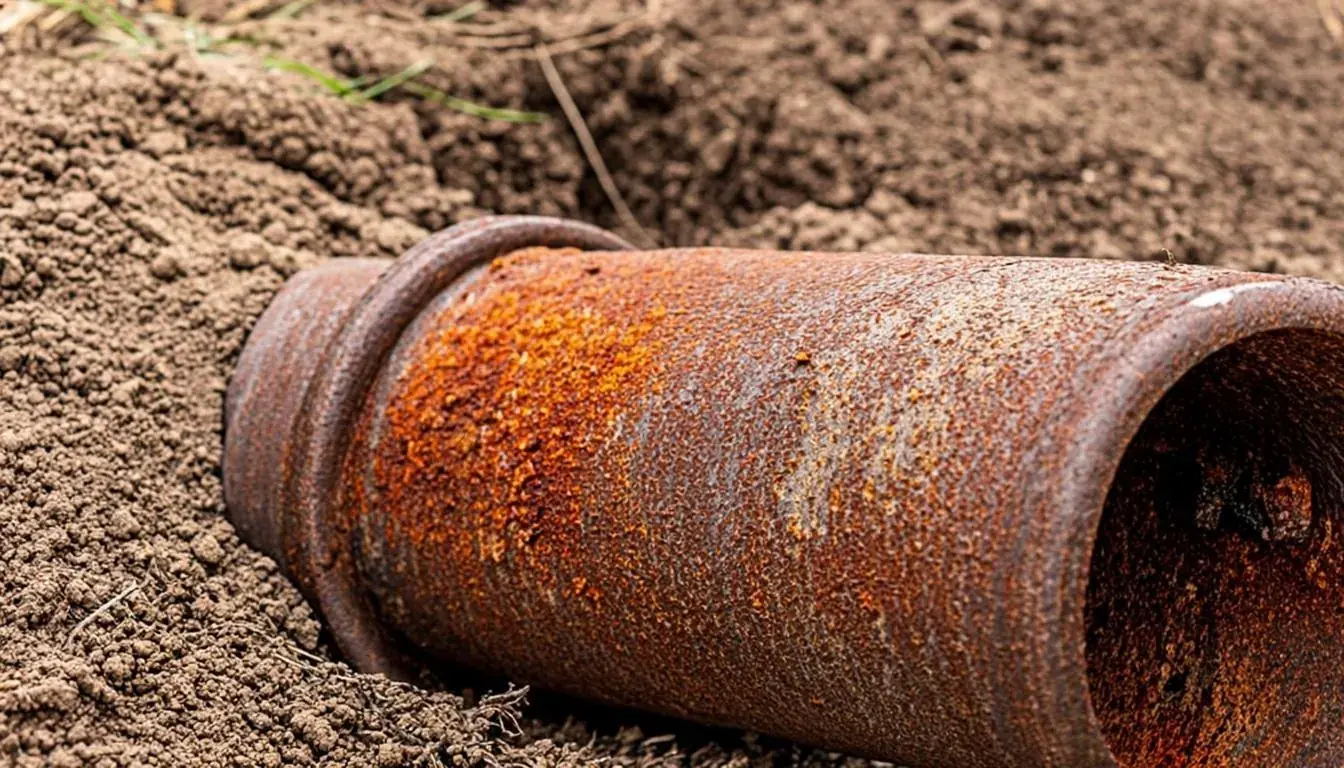
The Repair-to-Replacement Ladder
Most projects land somewhere on a ladder that runs from the smallest intervention to a brand new line, and the sewer line repair vs replacement decision gets easier once the options sit side by side. Each row of the table below shows a common approach and where it fits.
| Option | What It Involves | Where It Fits |
|---|---|---|
| Spot repair | Excavate and replace only the failed section | One cracked segment or offset joint in otherwise sound pipe |
| Section excavation | Open a longer trench and replace a stretch of pipe | Several adjacent defects or a short sagging run |
| Cured-in-place lining | A resin-saturated liner is pulled in and cured, forming a pipe within the pipe | Structurally sound pipe with localized defects |
| Pipe bursting | A new pipe is pulled through the old run, fracturing it outward | Failed lines where a full-length trench is impractical |
| Full replacement | Remove the old lateral and install a new line end to end | Collapsed, belled, or repeatedly failing pipe |
When Relining Works, and When It Does Not
Say it plainly: relining suits sound pipe with local defects. If the host pipe is round, supported, and free of collapse, a liner can seal cracks and joints and return the run to decades of dependable service. That is what lining was designed to do.
Collapsed or belled runs need replacement. A liner follows the shape it is given, so it cannot restore a pipe that has already lost its shape, and it cannot bridge a gap where the pipe has pulled apart. Bursting or open-trench replacement are the honest answers in that situation. A liner recommended for a collapsed line is the tool being sold, not the fix.
Disruption Tolerance Is a Real Input
The last input is personal. Some owners would rather open a trench across the yard and be finished in one project, while others are protecting gardens, hardscape, or a household schedule and want the smallest footprint available. Neither preference is wrong, but it belongs in the conversation before the scope is locked.
Name what you are unwilling to disturb. Driveway, pool deck, oak roots, irrigation mains: listing those constraints up front lets the plan route around them wherever the pipe condition allows.
When to Call a Professional in Sarasota
If you are weighing sewer line repair vs replacement for a Sarasota property, start with footage instead of a guess over the phone. Our sewer line repair team in Sarasota runs the camera first, maps every defect, and recommends the smallest scope that actually solves the problem, whether that is a spot repair, a liner, or a new line. Call (941) 337-1250 to schedule the inspection and put the decision on solid ground.
Related Services
The adjacent services below carry this job forward: